
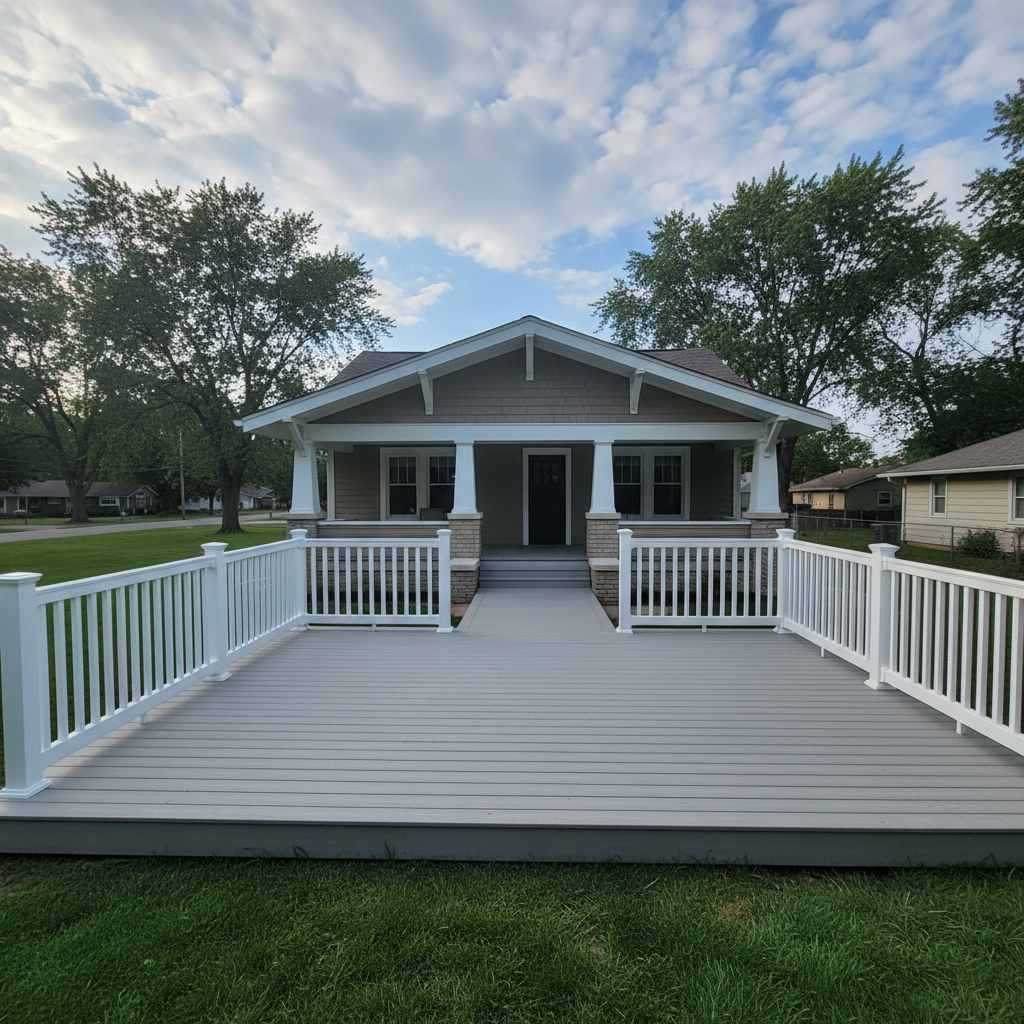
Most people start looking for a deck builder after they've already picked a color scheme or a composite brand off a showroom board. That's backwards. The thing that decides whether your deck is still solid in fifteen years isn't the color of the decking, it's what's underneath it, and whether the person building it understood the ground they were building on.
Kingston Mines sits close to the Illinois River, and a lot of the lots out this way have soil that holds water longer than you'd think from the surface. Central Illinois clay and silty loam don't drain the way sandy soil does. After a wet spring, a footing hole can sit full of water for days. A builder who's done this work around Tazewell County knows to dig past that, not just down to a number on paper.
Footings are where the whole job is decided
Frost depth in this part of Illinois runs around 42 inches. That means footings need to go down below that line, or the ground will heave them come January and February when the freeze-thaw cycle runs through its usual swings. A footing poured at 24 inches might hold fine for two winters and then start lifting on the third. You won't see it from the top. You'll notice it when a railing post starts leaning or a door at the bottom of the stairs stops closing right.
Ask whoever you're talking to how deep they go and why. If the answer is a shrug, or "however deep the last one was," that's your answer about them too. A builder who knows the area should be able to tell you the frost line without looking it up.
Permits aren't a formality out here
If the deck attaches to the house, or it's more than a certain height off the ground, it almost always needs a permit, whether you're inside the village or out in the unincorporated part of Tazewell County. The inspector is checking footing depth, the ledger board attachment to the house, joist spacing, and railing height if the deck sits high enough to need one. A good builder pulls the permit before the first hole gets dug, not after a neighbor calls it in.
Skipping the permit doesn't just risk a fine. It means nobody with county eyes on the project ever checked that the ledger board was through-bolted and flashed properly, which is the single most common failure point on an attached deck. When a ledger board isn't flashed, water gets behind it, finds the house's rim joist, and rots it from the inside where you can't see it until the deck starts to sag away from the house.
What a fair quote actually spells out
A real quote names the lumber grade, not just "pressure treated." It should say whether the structure is #2 Southern Yellow Pine or similar, what size the joists are and how far apart, 16 inches on center is standard, and what hardware is going into the connections. Galvanized nails next to composite decking will streak and corrode. Stainless or coated structural screws cost more up front and don't.
It should also say who's handling the permit, roughly how many days the framing will take versus the decking and railing, and what happens if they hit something unexpected, an old buried footing, a soft spot, a tree root running under where the posts need to go. Older lots around Kingston Mines, especially ones built decades back before anyone thought about future additions, sometimes have surprises in the ground. A one-line verbal estimate with no breakdown is not a quote, it's a guess with a dollar sign on it.
Material choices beyond the color swatch
Pressure treated lumber needs time to dry out before it'll take a stain, usually a few months to half a year depending on the summer. A builder who seals it in week one is sealing in moisture, and you'll see the finish peel the next season. Composite decking doesn't need staining at all, but it does need gaps between boards, usually around 1/8 inch, so it has room to expand in July and August heat without buckling. If a crew butts composite boards tight together because it looks cleaner on day one, you'll see ripples by the second summer.
Railings matter too. Code generally wants a 36-inch minimum height with balusters spaced so a 4-inch sphere can't pass through, which keeps small kids from squeezing between them. That's not decoration, it's the part of the deck that keeps someone from going over the edge.
The things that should make you walk away
- A price that's noticeably lower than every other bid with no explanation, usually means smaller footings, thinner joists, or no permit.
- Cash only, no written contract. If there's a dispute later about what was promised, you have nothing.
- No insurance certificate when you ask for one. If a worker gets hurt on your property and the company isn't covered, that liability can land on you.
- Vague answers about footing depth or frost line for this area. That's not a detail they should be guessing at.
- Pressure to sign same day. A deck is a few thousand pounds of lumber or composite sitting on your house's structure. It deserves more than a same-day decision.
None of this is complicated once you know what to ask. It just takes someone willing to answer plainly instead of talking around it. If you're weighing a new build, a repair on an old frame, or just want someone to look at a deck that's started to feel soft underfoot, Valor Outdoor Living builds and repairs decks around Kingston Mines and the towns around it, and we're glad to walk through what your specific lot and soil will need before anyone picks up a saw.