
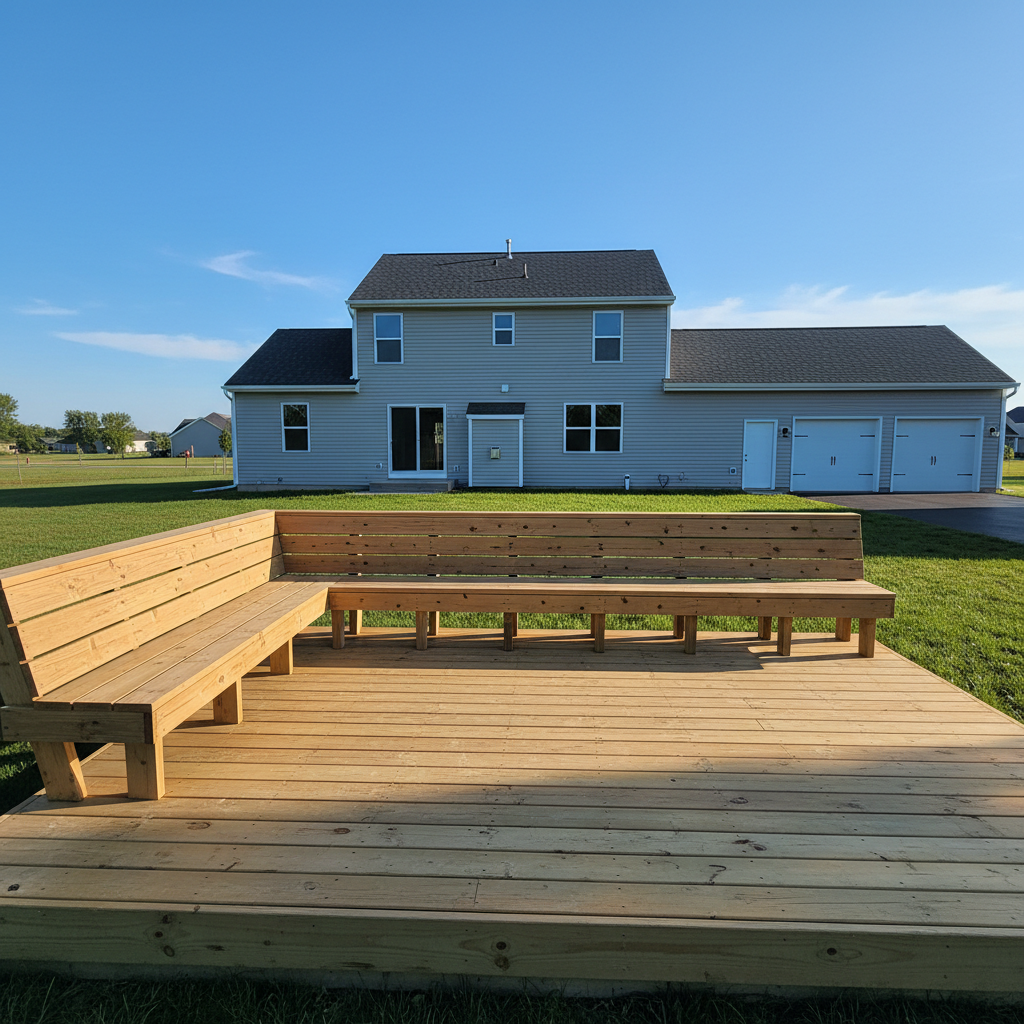
A homeowner asks this question almost every spring and almost every fall, and the honest answer depends on which part of the job you mean. Pouring footings, framing joists, staining cedar, and installing composite boards all have different weather windows. Get the timing wrong on one of them and you're not looking at a cosmetic problem. You're looking at a board that cups, a stain that peels in a year, or a footing that heaves out of the ground.
What the ground does here
Kingston Mines sits in the Illinois River Valley, and the soil changes depending on where you are on the lot. Closer to the river you'll find sandier, siltier ground that drains fast but can hold a higher water table than people expect. Up on the higher ground around town it's heavier clay loam, the kind that swells when it's wet and shrinks hard when it dries out in August. That swelling is what pushes old deck posts out of alignment over a few winters if they were never set below frost.
Central Illinois code generally wants footings 42 inches deep, below the frost line, so the ground under the concrete doesn't freeze and heave the post. That depth matters more here than in a lot of places, because the clay holds water right up until a hard freeze, then expands as it freezes. A footing poured at 24 inches in November might look fine in December and be an inch out of plumb by March.
The actual weather windows
Late April through June is usually the best stretch for new builds and framing. The ground has thawed enough to dig and pour, it's dry enough that trenches don't fill with water overnight, and the concrete can cure without freezing. Three to seven days gets a footing load-bearing enough to frame on, though full strength takes closer to 28 days.
September and October are the better months for staining and sealing, and this is where people get it backwards. They want to stain in July because the weather's nice, but Illinois summer humidity sits high enough that a stain can skin over on the surface before it's actually soaked in. Fall gives you cooler, drier air, usually two or more dry days in a row, and wood that isn't still releasing moisture from a humid summer. Most stain and sealer products want the air between 50 and 90 degrees and no rain for 24 to 48 hours after application. October in Kingston Mines gives you that more reliably than July does.
Composite decking is the one material that doesn't care as much about ground conditions, since there's no concrete cure involved on the board itself, just on the footings underneath. But composite boards expand and contract with temperature more than wood does, so installers leave a gap, usually around 1/8 inch per board, sized to the temperature at install. A deck built tight in January cold can buckle in July heat if that gap wasn't accounted for.
What winter is actually good for
Winter isn't dead time, it's planning time. Design meetings, material selection, permit applications, demolition of an old deck that's coming out anyway. Pulling down a rotted structure doesn't need warm ground, and getting a permit application in during January or February means you're not waiting in the spring line with everyone else who waited until the first warm Saturday to think about it.
Permits and inspections on a timeline
Depending on whether the property is inside village limits or out in unincorporated Tazewell County, the permit comes from a different office, but the process is similar either way. You submit a plan showing footing depth and spacing, the inspector checks setback from the property line, and there's usually a footing inspection before concrete goes in, then a framing inspection before decking boards cover the joists. If your footing inspection gets scheduled for a week when the ground is still frozen solid, you can't dig, and that's a delay that has nothing to do with the contractor being slow. Building in the shoulder seasons, March or late October, means working around weather that can flip from 60 degrees to a hard freeze in the same week.
HOAs aren't common in and around Kingston Mines the way they are in some of the newer subdivisions closer to Peoria, but if your lot is part of one, check the covenant before you pick a railing style or a stain color. It's a five-minute phone call that saves a rebuild.
Older lots versus newer ones
A lot of the housing stock around Kingston Mines and the surrounding towns was built decades ago, and those older decks were often framed with posts set directly in soil, no footing at all, or a footing poured shallow because the code at the time didn't require 42 inches. When we get called out to repair one of these, half the job is dealing with what's already in the ground rather than what we're adding. Newer construction nearby tends to have deeper, code-compliant footings already, so repair work there is more often about board replacement or railing damage than structural movement.
If you're not sure which category your deck falls into, the posts will tell you. Pull back the skirting or crawl underneath if you can, and look at how the post meets the ground. A post sitting on a paver or directly in dirt is a different repair than a post anchored to a poured footing that's just cracked.
So when should you actually call
If you want a new deck built this year, late winter is when you should be getting quotes and permits moving, so the crew can dig footings as soon as the ground allows in April or May. If you're staining an existing deck, aim for September. If a board's rotted or a post is leaning, that's not seasonal, that gets fixed whenever you notice it, because a soft board is a fall risk regardless of the month. Valor Outdoor Living works around these windows every year in Kingston Mines and the towns nearby, and we'll tell you straight if the calendar's working against the job you want done.